 When we are shown,
we come to know.
When we know,
we come to understand.
When we understand,
all will be well.
Old Māori saying (in Whitinui, 2013, p. 482)
Sound is movement of matter and a useful source of impressions of the world. It gives us information about geography, biology and anthropology, and I would add technology. The more developed our listening is the more skilled the practise of listening will be. This does not only concern indigenous tourism, but all forms of tourism. What is special in indigenous tourism is that there is no nature-culture divide. Culture is enacted through ways of knowing nature, being in nature and doing everyday tasks in nature in a way that becomes nature. Sound is hence an actor in the network of indigenous practices. Sound shows us the effect of matter and how nature materialises itself as culture in indigenous people. Nothing becomes a coincidence because everything is constantly moving in a dynamic relationship and comes along when its time has come.
In my initial ethnography in the Introduction chapter (p. 7) and in chapter 5 about hearing (p. 41), I introduced the meeting of the sound of the rustling leaves of the mountain birch and the yellow wagtail. These two sounds had much to contribute to the message underpinned in this thesis. First, the sound of the wagtail presents the sound of a complex collection of birds challenging the concept of species. This relates to the implications of the UN consideration of who is indigenous people and to the Sámi people, who’s community is challenged by static definitions. All life forms are dynamic, and the truth is partial. You cannot classify the yellow wagtail by its appearance, but the practices and sounds have similar patterns. Regarded as a primitive way of flying and a primitive sound, it is still clear and easily recognisable, qualities that are becoming ever more valued in a messy world. The wagtail has an important role in intermediating between insects and plants. They eat insects and produce nitrogen in abundance for the trees they inhabit. In return the tree provides shelter and pollen for more insects to come. Hence, the yellow wagtail practices sustainable jávredikšun to its meahcci.
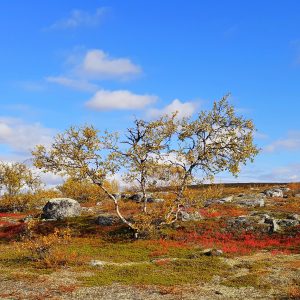 Then there is the sound of the leaves of the tree in my tree metaphor where I left each Sámi or Sámi family as moving leaves in a tree. The movement is dynamic and changes according to changes in the wind. It is necessary to change to be able to live within the everchanging environment. If you stop moving with, and try to move against, you will have problems hanging on. Trees prepare for harder climates by shedding their leaves and wrapping up life in sprouts in autumn, like people, who hunt and gather for winter and then wrap up inside houses. They will all appear in spring for sun and warm weather to nourish their bodies again. Every act is individual and situational according to seasonal changes in the environment. Leaves on a tree are not alone in the world, they hang together on the tree and some leaves cover each other partially and have a partial experience of the environment. Trees are also known to communicate and provide for each other. Together they make up the tree with its stem and roots. The roots provide nutrition and water, but it is up to the leaf to perceive the environment and take advantage of what is needed to grow. By growing, it gives something back to the tree so that the whole tree can grow. Like the entire Sámi people. The individual tree gives back to the forest so that it can grow strong and breathe the world, reducing carbon dioxide and providing oxygen, like the Sámi provide other indigenous communities with nourishment to fight for their rights. They also believe that the tree nourishes them when they are alive, and when they die, they return to the soil and nourish the trees. Everything goes into an eternal ecological cycle.
Piera’ s concept of Verdde tourism are (re)establishing bits and pieces of what colonisation has taken from the Sámi people. He shows his care for the past, the present and the future and bring them together in a tourism context. My studies of the soundscape have found that without sound I would not have heard these stories and have not been able to experience the traditional skills Piera has developed to mastery – a mastery of caring for those that passes by. Verdde tourism is hence a form of jávredikšun that make caring an important ecological tool.
9.1 Final thoughts
In my research on soundscapes I have found that the sound and the characteristics of sound shows the effect that materiality of sound enact. This effect is highlighted by attending to sounds in embodied soundscapes. I have also found that by noticing what is not seen with our eyes we can enable authority to be given to different ways of knowing. I have also briefly mentioned how the Verdde tourism concept is a sustainable tourism concept that enable the practitioners to forward their stories, ways of knowing, being and doing their traditions and rebuild what has been repressed. All these aspects are things that I was not able to investigate further within the scope of this thesis, but I hope to pick them up in my further research if I have the opportunity.