Getting Religion in Memphis (travelog entry 13)
I’ve never really been an Elvis fan. My musical consciousness begins in 1977, the year Elvis died and a new wave of punk music exploded into what I always thought was a somewhat stale musical landscape of bands like Yes, Emerson, Lake and Palmer, and Led Zeppelin, with their endless guitar heroics. There was lots of cool music, but it seemed to me that it all came from a bygone era – the Beatles and the Velvet Underground had broken up, and Jimi Hendrix and Jim Morrison were dead. And then all of a sudden, there was all this raw power: the Sex Pistols, the Clash, the Damned, Sham 69, Stiff Little Fingers, Siouxsie and the Banshees, the Buzzcocks, the Jam, the Cramps, the Ramones, Iggy Pop, and contemporary music became cool. So I buried Elvis with no regrets. (I don’t mean in 1977, when I was too young to be paying attention, but a few years later, when my friends Hrathkus and Radagast and Jeff and Sean and Beth and especially Colin turned me on to the great new punk bands and the New Wave. Colin Crain had been to England and he had discovered all kinds of cool music.)
But Egon has been preaching the gospel of Elvis to me, and I’m listening. He stresses how Elvis started it all — without Elvis, there would be no Cramps, no Iggy, no rock ’n’ roll at all, according to Egon. Egon explains how Alex Chilton produced the Cramps’ debut album, Songs the Lord Taught Us, in Memphis, and plays a playlist that intersperses Alex Chilton’s band Big Star with Elvis and with the Cramps. The playlist takes on a new dimension with the history lesson.
Our pilgrimage to rock’s holiest shrine is immensely satisfying. I hate crowds but they are smoothly managed here and an incredibly efficient operation channels the thousands of daily visitors through so that they can see everything at a relaxed pace without traffic jams. The house, we are told, is just the way the King left it the day he ceased performing (Elvis only entertained downstairs, so the upstairs is off-limits, out of respect for his privacy). We don headsets and walk through the tour, hearing clear explanations and some reminiscences by Lisa Marie Presley.
We see his living room with green shag carpet on the ceiling and other garish 1970’s nouveau riche features. As my brother Ian has pointed out, the specific details don’t say much about Elvis. Most likely, Elvis’s interior decorator picked them out, and if he had lived another couple of years he would have had the whole thing remodeled again and it all would have looked different. Mostly what’s on display is an arbitrary frozen moment in time. But still, you feel like you are getting to know Elvis, you’ve been invited into his house and you’re just wandering around a little while he is freshening up with some pills in the bathroom in preparation for a dune buggy race on the lawn.

The Tomb
But Elvis never comes out of the bathroom. Elvis and his parents are buried in the back yard and there are fresh flowers all over the grave as if he just died yesterday. Middle-aged women are quietly shedding tears. There is a respectful mood in the crowd and Egon is not cussing. When our part of the line moves past the grave we photograph each other and instead of grinning for the camera we put on somber faces.
Even more fun is Sun Studio, opened by Sam Phillips in 1950. A knowledgeable rockabilly tour guide with pink hair takes us through the tiny space and tells us the history of the storied place, with anecdotes about some of the earliest and greatest rock legends who recorded here, in a room the size of a one-car garage. We heard Jackie Brenston and Ike Turner on what she said was the first rock ’n’ roll record ever recorded.
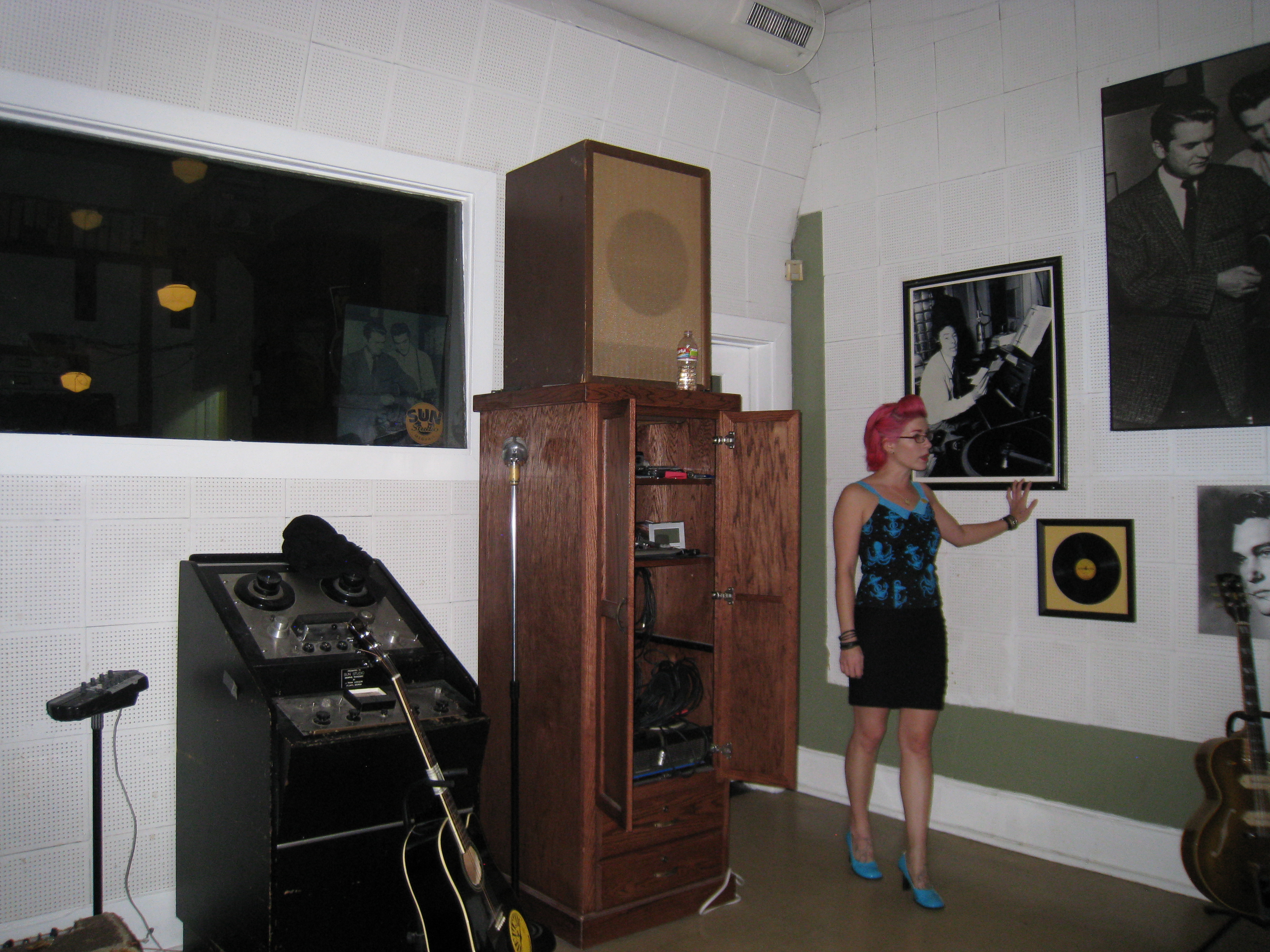
Tour of the studio
She played a bit of Johhny Cash, and demonstrated how he achieved a kind of snare-drum rattle in his guitar by shoving a folded bill into the frets. She played some Roy Orbison and a little bit of the “Million Dollar Quartet” of Elvis Presley, Jerry Lee Lewis, Johnny Cash, and Carl Perkins. One of the most amazing things is that Sun is still operating (or more accurately, operating again) as a recording studio, at night so that they can milk the lucrative tour business during the day. They apparently have some new recording equipment but nothing we see on the tour looks like it has been upgraded since the 1950’s.
I buy a collection of early Sun recordings in the gift shop and Egon comments that it is not the sort of thing I would have bought back when Egon was running his amazing record shop in Tromsø. He’s right, I have a newfound respect for 1950’s music.
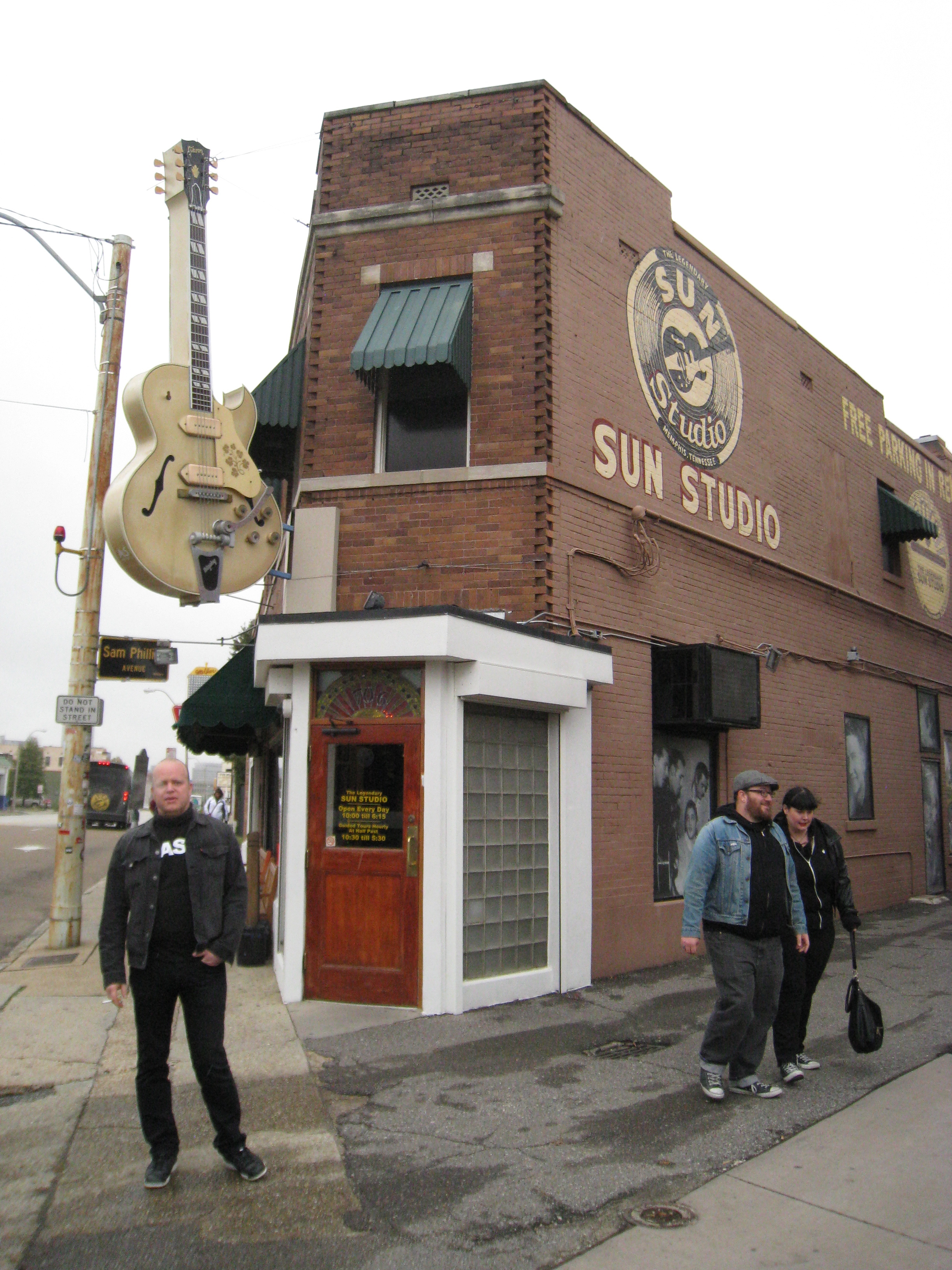
Sun Studio in Memphis
After Sun we went to Goner Records, the record store opened by Greg Oblivian. Egon closed his record store for good in 2004 but he still really appreciates a good one. In DC, he and Ian traded tips about record stores, and Ian gave us a list of record stores to hit across the country (Ian knows the country well from all his touring), but Egon already knew about this one which is famous in the garage rock scene (and besides, Egon knows Greg Oblivian from booking him in Tromsø). This record store was excellent, nearly all vinyl, with a highly selective section of CDs. Egon immediately hit it off with the guys working there, impressing them with his voluminous knowledge of rock. He even found a Cramps bootleg there that he didn’t know existed.
Leaving the record store with a treasure chest full of precious vinyl, we then headed for Gus’s World Famous Chicken. Memphis has already been filled with religious experiences, but this one is for the sense of taste. The place is wholly unpretentious, in fact sort of cheap-looking with plastic red and white checked table cloths, but we have heard that the southern style fried chicken is to die for and we are not disappointed. The perfectly crispy, slightly spicy crust snaps under your teeth and the perfectly moist, richly flavorful chicken simply melts in your mouth. Eating there is like being washed of all your sins.

Insanely great southern fried chicken
So if Memphis is Jerusalem (Tupelo would be Bethlehem), and Graceland is the Church of the Eucharist (with Golgotha in the back yard, by the pool), and Sun Studios is the site of the Last Supper (where all the apostles gathered, and Sam Phillips sold Elvis to RCA for 35,000 dollars), then Gus’s would be the site on the Jordan where John baptized Jesus. Egon seems to think I might be overdoing it a little with all this religious talk, but he’s the one who played all those country songs wailing about Jesus for hours back in Tennessee.
